
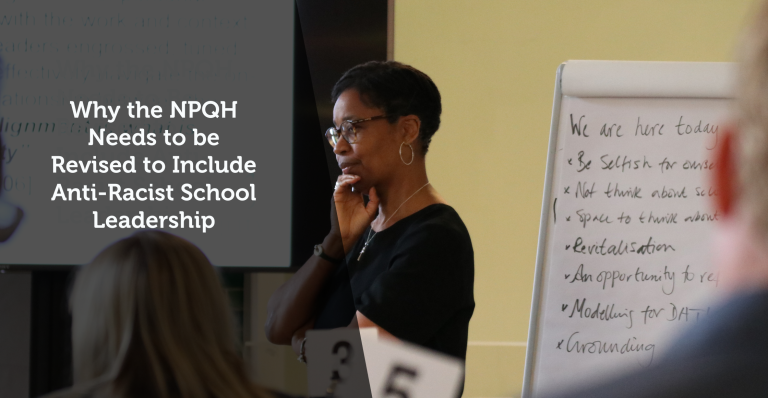
Why the NPQH Needs to Be Revised to Include Anti-Racist School Leadership
In the aftermath of this summer’s race riots, one of the critical questions those if us in education must ask is:
“What role do school leaders need to play in ensuring such events never happen again?”
The Shortcomings of Current Leadership Training
Every year, hundreds of aspiring head teachers apply for and complete the NPQH (National Professional Qualification for Headship). This qualification is widely believed to prepare them for the diverse challenges of school leadership. However, this training largely overlooks the essential content for what strong, confident anti-racist school leadership looks like. It fails to address what it truly means to educate our children as global citizens.
The leaders of tomorrow are being shaped in our schools today. Yet, change is impossible if today’s leaders are not equipped with the anti-racist knowledge, skills, and tools necessary to prepare future leaders to create a more just and equitable world for all.
The Importance of Anti-Racist Leadership
We can only hope for a better tomorrow and dream of a world where racism no longer holds a pernicious grip on the minds of our youth when every school leader—especially those aspiring to headship—feels confident about the role they must play in helping to eradicate racism.
We severely short-change our children and future generations when the inner work of anti-racism, and what it means to commit to a world free from racial prejudice and oppression, is excluded from NPQH training for future head teachers.
Moving Beyond Tokenism
There can be no more excuses, no more token gestures and no more allowing matters of race and oppression to be pushed to the margins of the NPQ leadership curriculum. The legacy of racism and colonialism is deeply embedded in our collective and individual psyches. As the Jungian author James Hollis suggests that which is suppressed will eventually manifest as fate. This summer’s race riots starkly illustrated this truth.
Within our current education system, too many educators are still encouraged (both explicitly and implicitly) to ignore and suppress the reality of racism, pretending it doesn’t affect their lives. Surely, this summer’s race riots have shown this to be untrue. Whether one is racialised as white, black, or brown, racism affects us all. As educators, we are all called to define what it means to have a moral compass and to ensure that in the fight against racism, our moral compass always points due north.
The Dual Nature of Anti-Racist Work
Being anti-racist means recognising not only the external actions needed to bring about change but also the internal, personal inquiry that must accompany the transformative change our society needs. As Parker J. Palmer wisely notes, “When you realise that you can no longer collaborate in something that violates your own integrity, your understanding of something is suddenly transformed.” Any revised version of the NPQH has to have this as a central tenant; enabling future school leaders to see the truth behind systems of oppression and racial inequity and the actions that school leaders can take to help remedy this.
Urgent Need for NPQH Reform
The NPQH must, as a matter of urgency, reconsider how its curriculum has contributed to an environment in some schools where racism is not adequately addressed because school leaders have not been taught how to confront it. If integrity is at the heart of the NPQH—if it aims to help school leaders embrace values that are lived and truly transformative—then it must seek to transform its content and delivery. This is the only way to ensure that we never again witness children and teenagers engaging in the kind of activities seen over the summer.
Laying the Foundations
In many of our schools, what I term “foundational work” has already begun: policy review, decolonising the curriculum, etc. But this is only the beginning. Developing an ethic of social responsibility and social consciousness that does not falter in the face of overt /extreme acts of racism requires school leaders and educators to cultivate the internal capacity to remain in constant dialogue with the challenges that arise whenever racism rears its ugly head.
A Call to Reassess NPQ Leadership Qualifications
The summer riots have shown us once again that when stoked by centuries of lies and aggression, it takes only a spark to ignite a fire. The NPQH and other NPQ leadership qualifications must now be urgently reassessed; it can no longer be argued that they are fit for purpose in their current form.
We all know that the world we live in is not equal or just, or fair and that society is deeply at risk of unravelling. Yet, we cannot give up hope and … School leaders can be both purveyors of hope and part of the solution, but this cannot happen if the NPQH remains unchanged.
An Invitation
On 1st October, 4.00pm – 5.00pm, Viv Grant, Director of Integrity Coaching, will host a Race, Identity & School Leadership Webinar specifically for white school leaders who want to lead race work with greater confidence and self-assurance. Viv is passionate about race work in schools, and her PhD research focuses on ways to enable white school leaders to claim their agency as anti-racist educators. Viv will create a safe space for individuals to explore related themes and discuss collaborative opportunities for building on race work that some schools may have already started. To book your place register your interest here.
Or please find out more by contacting Hannah at hannah@integritycoaching.co.uk.
Don’t miss this opportunity—secure your spot today!

